
How to Audit a Slow-Moving Real Estate Project Before Spending More on Marketing

By Kauser Ahmedd, Founder and Managing Partner, Kanopy Ventures | Published by Kanopy Ventures

A real estate sales audit checks the whole path from market and product to price, positioning, leads, presales, site visits, closure, channel partners, and CRM, before spending any extra marketing money is spent. Work from the outside in, find the weakest link with evidence, and fix that first. Marketing spend only helps if the rest can convert it.
Why the audit comes before the budget
When bookings slow down, the budget conversation usually starts in the same meeting. More spend on digital, a new hoarding, a bigger channel partner incentive. It feels like action.
The trouble is that a slow project rarely has a single cause that more marketing can fix. The product may not suit the micro market. The price may sit above what comparable projects realize. The message may promise something the site visit does not deliver. Presales may be reaching half the leads. Channel partners may have stopped showing the project. Any of these makes new marketing money less productive, and several together can make it close to wasted.
An audit is the discipline of finding out which of these is true before you spend. It does not need to be elaborate to be useful. It needs to be honest, in the right order, and based on evidence from your own project.
For a quick look at the most common causes, read why a real estate project isn't selling. This article shows how to turn that list into a structured check.
Audit from the outside in
A useful rule is to start with what the buyer sees first and what you cannot change easily, change and move towards what you control directly. That gives this order:
Market and competition
Product and configuration
Pricing and inventory
Positioning and message
Leads and presales
Site visits and closure
Channel partners
CRM and reporting
Problems earlier in the list make everything later harder. If the product and price don't fit the market, even perfect presales will struggle. If they do fit, a weakness later in the list is where the leak is.
The eight areas, and the question to ask in each
1. Market and competition
The question: Is the project aimed at a market that exists, at a price that the market will pay, and do we know what the buyer is comparing us with?
Look at who is actually buying in the micro market, what nearby projects offer, and what they realize per square foot after concessions. Visit competing projects as a buyer would. Micro markets in Bengaluru don't behave alike, so don't carry a conclusion from one corridor to another.
2. Product and configuration
The question: Does the product mix match what the target buyer wants?
Look at which configurations are selling and which are not. Look at layouts, sizes, and amenities from the buyer’s side. A project where one configuration has sold out, and another has barely moved tells you something about the product mix.
3. Pricing and inventory
The question: Is the effective price in line with the market, and is the remaining stock stuck for a reason?
Compare effective price with comparable projects, not only the price list. Then review unsold units one by one and ask why each remains unsold. Our articles on selling unsold inventory without destroying your price and on why discounting is not always the answer explain what to do with what you find.
4. Positioning and message
The question: Can we say in one sentence why this buyer should choose this project, and does the site visit confirm it?
Compare what the advertising promises with what the buyer experiences on site. A gap between the two is one of the quickest ways to lose trust. Check what a buyer finds when they search for the developer and the project online, since trust is built before the first visit.
5. Leads and presales
The question: Are the right people enquiring, and are we reaching and qualifying them well?
Look at lead sources and their quality, how quickly you reach leads, how many connect, and how consistently you qualify them. Listen to recorded calls. Variation between callers is often larger than variation between campaigns.
6. Site visits and closure
The question: Do buyers who reach the site come back and book?
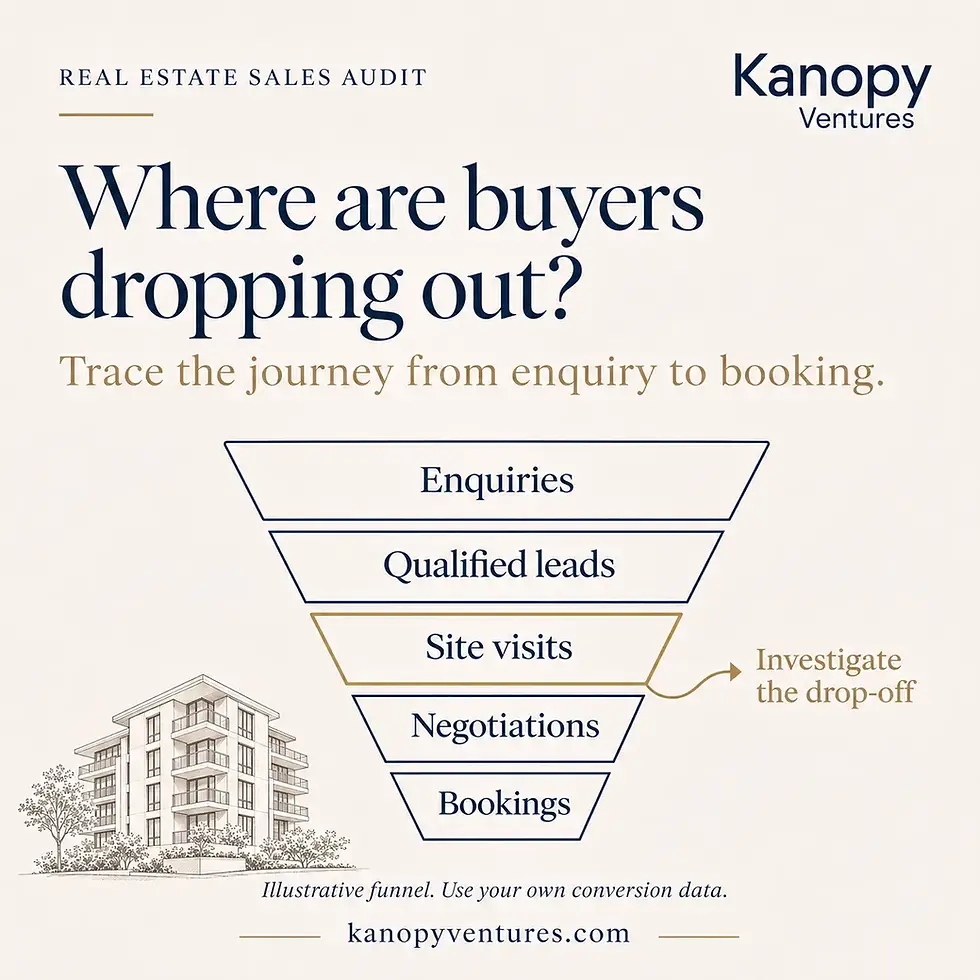
Look at the share of scheduled visits that happen, how many buyers revisit, how many reach negotiation, and how many book. Read the reasons for loss. For a full view of the stages and what each should show, see the complete real estate sales funnel.
7. Channel partners
The question: Are channel partners active, confident, and supported?
Look at which partners are bringing visits, which have gone quiet, and what they say about the project. Check that availability information is current, lead registration is clear, and payouts are on time. Partners sell projects they trust and can access easily.
8. CRM and reporting
The question: Can the CRM tell us where buyers are lost?
If source, stage, timestamps, and lost reasons are not recorded, the audit itself will be harder, and so will every later decision. Many projects use a CRM as a contact list, not a measurement system.

What data to gather first
Audits fail when they start with opinions. Gather these before the first meeting:
Sales by month and by configuration, against the original plan
The unsold inventory list, unit by unit
Price list and a record of concessions given
Lead data by source, with stage and outcome.
Site visit and booking records, with lost reasons
Marketing spend by source, and what a booking has cost (see CPL versus cost per booking)
Channel partner list with activity
Notes from competitor visits
If some of this does not exist, that is itself a finding.
An illustrative self-check scorecard
The table below is an illustrative starting point for a first review. It is not Kanopy’s full audit, which requires access to project data and market visits. Score each line honestly as Red (a clear problem), Amber (unsure or mixed), or Green (evidence says it is sound).
Area | Check | Red, Amber or Green |
Market | We know what nearby projects realise per square foot after concessions | |
Market | We have visited competing projects in the last quarter | |
Product | Every configuration has some demand | |
Product | Layouts and amenities suit the buyer we have defined | |
Pricing | Our effective price is in line with comparable projects | |
Inventory | We know why each unsold unit is unsold | |
Positioning | We can state in one sentence why a buyer should choose us | |
Positioning | The site visit matches what the advertising promises | |
Leads | We know which sources bring buyers who visit and book | |
Presales | We reach and qualify leads quickly and consistently | |
Site visits | Most scheduled visits happen and many buyers revisit | |
Closure | We record why buyers do not book and act on it | |
Channel partners | Our partners know current availability and are active | |
CRM | Source, stage and lost reason are recorded for every lead |
How to read the result
Do not add up the scores into a single number. A project with one serious Red in product and everything else Green has a different problem from one with scattered Ambers.
Instead, apply three rules:
Work from the top. The first Red in the list, in the order given above, is the one to fix first, because later areas depend on it.
Treat Amber as missing evidence. If you cannot say whether something is sound, you do not yet know. Find out before acting.
Fix before spending. Only after you address the main Reds should you decide whether more marketing is needed, and what it should do.
Why an outside view can help
An audit done by the team that runs the project has a built-in problem. People are close to their own decisions. The sales head may not see how a script sounds to a buyer. The marketing team may not see that the product mix is the issue. The developer may not want to hear that the price is above the market.
That does not mean an outside party is always needed. A disciplined internal review, with honest data, can find a great deal. It does mean that when the same problem keeps coming back despite internal effort, a fresh pair of eyes and market access are worth considering. Our view, shaped by Kauser Ahmedd’s roughly 23 years in Bangalore real estate, is that price should come from the market and not from what the developer feels, and that profit should not be the first concern when the market is telling you something. Those are the points a project’s own team finds hardest to accept.
Common audit mistakes
Starting with marketing because it is the most visible activity
Using opinion in place of data
Looking only at the funnel and skipping the product and price
Looking at overall figures and missing differences between configurations
Treating every Red as equally urgent
Collecting findings but not assigning owners and dates
Stopping after the first fix, without checking whether the result changed
Why your audit will not match anyone else’s
Developers sometimes ask for standard figures to measure themselves against. We do not offer them, because any single number would mislead.
Funnels are not standardized. Each has its own mix of product, price, and market. Villas convert well in some areas and slowly in others. Farmland converts at a low rate and site visits take longer. A reading that is healthy for one product can be a warning for another. The right comparison is your own project against its own earlier months and against its own plan.
Frequently asked questions
What is a real estate sales audit?
A structured review of why a project is selling slowly. It checks the market, product, price, positioning, leads, presales, site visits, closure, channel partners, and CRM using the project’s own data to find the weakest link before spending more money.
How do you audit a slow-moving real estate project?
Start from the outside in: market and competition, product and configuration, pricing and inventory, positioning, leads and presales, site visits and closure, channel partners, then CRM. Gather data first, score each area honestly, and fix the earliest serious problem first.
Why audit before increasing the marketing budget?
Because slow sales usually come from several causes, many of which marketing cannot fix. If the product, price, or conversion process is weak, extra spend adds to the leak instead of to bookings.
What data is needed for a sales audit?
Sales by month and configuration against plan, unsold inventory by unit, price list and concessions, lead data by source and stage, site visit and booking records with lost reasons, marketing spend, channel partner activity and notes from competitor visits.
How long does a project sales audit take?
It depends on the project and how complete the data is. A first review of the available data can be done quickly. A deeper audit that includes market visits, call reviews, and partner conversations takes longer.
Can a developer audit their own project?
Yes, with honest data and a disciplined process. The risk is that people close to their own decisions miss problems. If the same issue keeps returning, an outside view can help.
What is the most common cause of slow real estate sales?
It varies by project. Common causes include a product mix that doesn't suit the market, a price above comparable projects, weak positioning, slow presales, low site-visit conversion, and inactive channel partners. An audit identifies which factors apply to your project.
Before You Spend More on Marketing, Find Out What Is Slowing Your Project
For a real estate developer, success is not measured by the number of inquiries or the size of the marketing budget. It is measured by sales velocity, inventory absorption, revenue realization, and predictable cash flow.
At Kanopy Ventures, we work with developers in Bangalore to understand what is slowing down project sales and fix it. From market-aligned pricing and project positioning to channel partner activation, presales management, site visit conversions, and closures, we take responsibility for the sales process, not just lead generation.
Because every unsold unit represents capital waiting to be realized, and every wasted marketing rupee represents capital that could have gone into the real fix.
Whether you are preparing for a new launch, struggling with slow-moving inventory, or looking for a dedicated sales mandate partner, let’s discuss how Kanopy Ventures can improve your project’s sales performance.
Let’s Discuss a Sales Audit for Your Project


