Why Are Your Real Estate Leads Not Converting Into Site Visits?

Published by | Kauser Ahmedd | Founder | Kanopy Ventures
Real estate leads fail to become site visits mainly because of presales gaps: slow first response, scripted calls with no project story, loose qualification, brochure only WhatsApp messages, and vague appointments. More lead volume does not fix this. Measure the connect, qualification, scheduling, and show rates first, then decide whether the media budget needs to change.
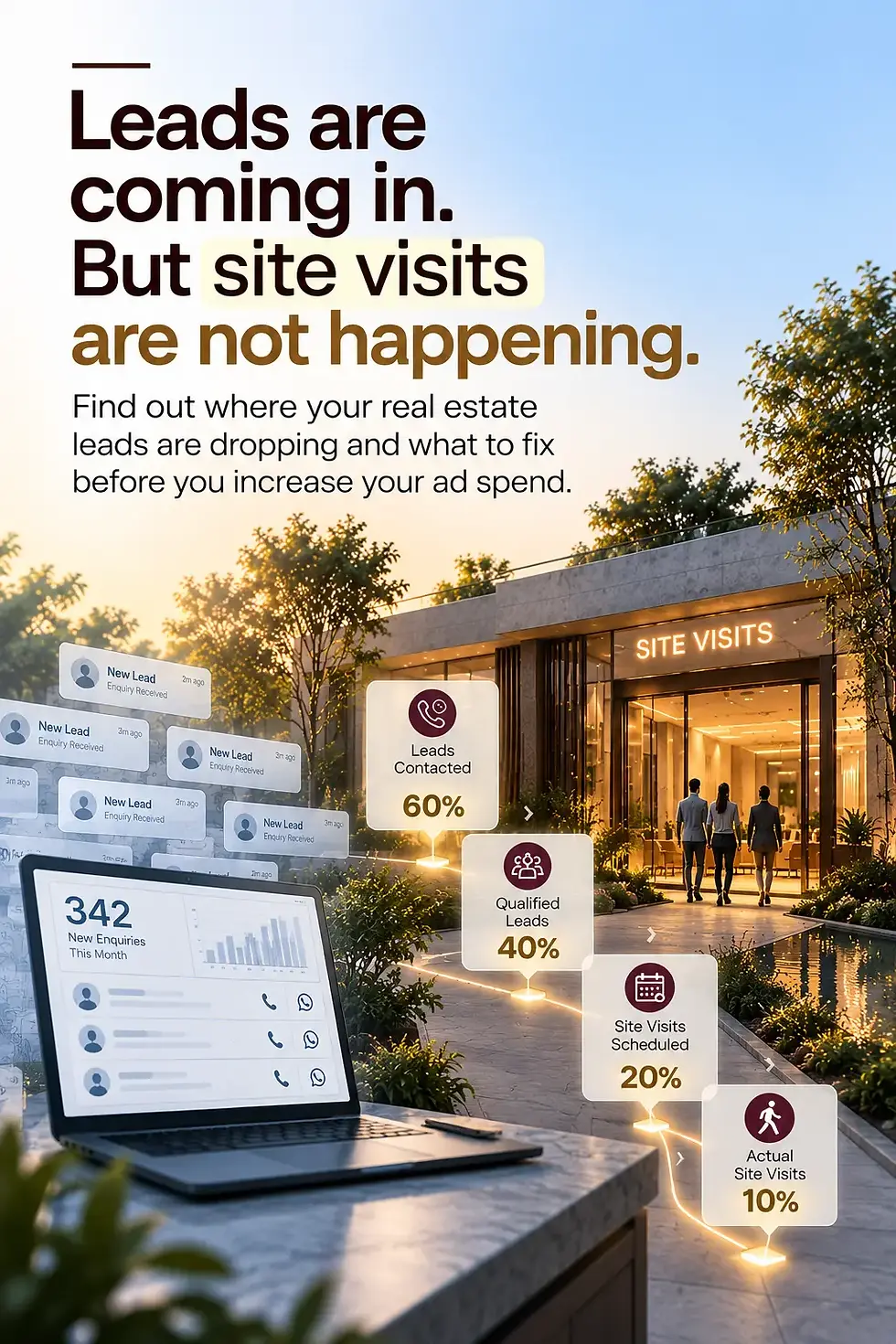
Why more leads will not fix a broken presales process
A developer in Bengaluru usually spots this problem on a Monday review. The campaign is running, the CRM shows several hundred new inquiries for the month, the cost per lead looks acceptable, and the sales head reports that the site visit calendar for the week is thin.
The instinct is to ask marketing for more leads. It feels logical. If 5 in 100 leads become visits, then 1,000 leads should give 50 visits.
That arithmetic only holds if the process behind the 5 is healthy. If the presales team reaches only half the leads, qualifies them loosely, and follows up for two days before giving up, then doubling the leads doubles the load on a process that is already leaking. You pay twice for the same leak.
The stage between a lead and a completed site visit is the first place where marketing spend turns into sales opportunity. It also gets the least management attention because it sits between the marketing team, which owns the lead, and the sales team, which owns the visit. In many developer organizations, nobody fully owns it.
This article covers only that stage. For the full journey from inquiry to booking, read our guide on where the real estate funnel is breaking, and for the complete model, see the real estate sales funnel.
Where leads drop between inquiry and site visit
Not every drop is the same kind of problem. Before changing anything, identify which one you are looking at.
What you see | Likely cause | What to check first |
Many leads never answer the phone | Slow first contact, wrong calling windows, poor lead source | Time between inquiry and first call, number of attempts, source-wise connect rate |
Leads answer but show no interest in a visit | Weak call quality, unclear project story, wrong buyer | Call recordings, script, qualification questions |
Leads show interest but never fix a date | Weak appointment setting, price or location doubt unresolved | Objection log, whether a specific slot is offered |
Visits are scheduled, but people do not turn up | No confirmation routine, low trust, wrong intent | Reminder process, show rate by source |
Visits happen, but quality is poor | Qualification is too loose | Budget, timeline,ne and purpose captured before the visit |
Each row points to a different fix. Applying a general "improve conversion" instruction to all of them wastes weeks.

The nine places leads are lost before the site visit
1. Response time
The first call decides a lot. A buyer who enquired on a portal or a social ad has usually enquired with several developers on the same day. The first project to respond sensibly often gets the first conversation.
Check the actual gap between inquiry time and first call, split by hour of day and day of week. Leads arriving at night or on weekends are frequently picked up on the next working day, by which point the buyer has already spoken to someone else. Presales rosters often follow office hours, while buyer inquiries follow personal schedules.
2. Call quality
A presales caller who reads a script, lists amenities, and asks "when can you visit?" is doing data entry, not selling. A good caller can explain in two sentences what the project is, who it suits, where it sits in the micro market, and why it is worth the drive.
Listen to twenty recorded calls from different callers. Most developers find the variation between callers is larger than the variation between campaigns. If one caller converts leads to visits at twice the rate of another on the same lead pool, the lead is not your problem.
3. Qualification
Qualification is where many teams go wrong, both ways. If it is too strict, you screen out genuine buyers because they don't share budget details on the first call. If it is too loose, the calendar fills with people who were never going to buy, the site team gets tired, and the visit-to-booking number looks worse than the product deserves.
A workable first call captures five things: purpose (self-use or investment), budget range, timeline, current location, and family decision-makers. Without these, a site visit is a guess.
4. WhatsApp communication
For many Bengaluru buyers, WhatsApp is the real channel after the first call. What gets sent matters.
Common problems: sending a heavy brochure PDF without context, sending the same broadcast message to every lead, not replying personally to questions, and sending messages at odd hours. A short, specific message that references what the buyer said on the call, followed by the location pin and one clear next step, performs better than a brochure alone.
5. Price communication and pricing objections
Developers often avoid sharing price early because they fear losing the lead. The result is the opposite: the buyer builds a number in their head, finds out later that it is far off, and drops out silently.
Share an honest price range early, along with what it includes and what it does not. A buyer who knows the range and still agrees to visit is a better lead than one who was kept in the dark. If many leads drop after the price conversation, that is useful information about pricing vs. the market, and it should feed back into the pricing discussion, not get buried in the CRM. Our view on how to set pricing is in the real estate pricing strategy guide.
6. Location objections
Some leads drop because they don't understand the location. A buyer who sees "North Bengaluru" in an ad may not know that the site is well connected to a road, an employment hub, or a school belt. Another may be worried about travel time.
Log every location objection in the CRM with a reason code. After a month, patterns appear: distance from workplace, doubts about future infrastructure, or confusion about which micro market the project belongs to. Each calls for a different answer, and a good presales caller carries it ready.
7. Follow-up discipline
Most buyers need several touchpoints before they commit to a visit. Many teams stop after two or three calls. Others follow up often but repeat the same message every time.
Set a clear follow-up rule: how many attempts, over how many days, and what new information goes into each touchpoint (a new photo of site progress, a nearby infrastructure update, a unit that suits their budget). Then audit whether the rule is followed. CRM data usually shows that discipline falls sharply after the first week.
8. Appointment setting
"Come whenever you are free" is not an appointment. Appointment setting requires a specific slot, a named person who will receive them, a short note on what the visit will cover, and a confirmation message the day before.
If scheduled visits are strong but completed visits are weak, the problem is almost always here and not in media. Measure show rate separately from scheduling rate.
9. Trust
Buyers deciding on a home or a plot are putting in a large part of their savings. They check the developer's history, delivery record, RERA registration, online reviews, and what other buyers say. A weak or missing digital presence makes a buyer hesitate to take a Saturday out of their week to visit.
This is why Kanopy treats a developer's reputation as groundwork before performance marketing. A project with a verified Google Business Profile, a clear website, honest reviews, and visible updates converts the same lead more easily than one without them. If your leads answer calls but refuse to visit, test whether a buyer who searches your project name online finds something reassuring.
A simple diagnostic for the lead-to-site-visit stage
Measure the stage in pieces, not as one number. Here are the formulas.
Metric | Formula |
Connect rate | Leads connected ÷ total leads |
Qualification rate | Qualified leads ÷ connected leads |
Scheduling rate | Visits scheduled ÷ qualified leads |
Show rate | Visits completed ÷ visits scheduled |
Lead to completed visit | Visits completed ÷ total leads |
Cost per completed visit | Total spend ÷ visits completed |
Illustration with hypothetical numbers (not a benchmark):
Stage | Count | Stage conversion |
Leads generated | 1,000 | n/a |
Leads connected | 640 | 64% |
Qualified | 280 | 44% |
Visits scheduled | 120 | 43% |
Visits completed | 70 | 58% |
With a spend of Rs 5,00,000, the cost per lead is Rs 500, but the cost per completed visit is about Rs 7,143.
Read the table carefully. A quarter of leads are never reached, fewer than half of qualified leads agree to a date, and four in ten scheduled visits don't happen. The campaign may be fine. The two stages to fix first are scheduling and show rate, because they sit closest to the visit and require no extra media spend.
These numbers are for explanation only. Do not compare your project to them.
Why there is no single "good" number
Developers often ask what lead-to-site-visit rate they should expect.
Our view, shaped by Kauser Ahmedd's roughly 23 years in Bangalore real estate, is that funnels aren't standardized. A villa project in one corridor behaves differently from an apartment project in another. Farmland converts at a llowerrate and takes longer fto move rom lead to visit. Ticket size, buyer type, and lead source all change the pattern. A rate that looks poor for one product can be healthy for another.
The better comparison is your own funnel over time and across lead sources. If your connect rate is falling month on month, or one caller is clearly doing better than another, you have something concrete to act on.
What to fix first
Fix in this order, because each step depends on the one before it:
Response time and calling windows
Qualification questions and call script
Appointment setting and reminders
Price and location objection handling
Follow-up rule and CRM discipline
Trust signals: digital presence, reviews, project updates
Only after these should you ask whether the lead source or the media budget needs to change.
Frequently asked questions
Why are my real estate leads not converting into site visits?
Most often because of slow first response, weak qualification, vague price communication, and inconsistent follow up. These are presales process issues rather than media issues, and they are found by measuring each stage between lead and completed visit.
What is a good lead to site visit conversion rate in real estate?
There is no universal number. It depends on the product, ticket size, location, lead source,, and how strictly leads are qualified. Track your own rate by source and over time instead of comparing it with an outside figure.
Should I increase my ad spend if site visits are low?
Not before auditing the presales process. If a large share of leads is never reached orare never offered a firm appointment, extra leads will mostly add to the leak.
How quickly should presales respond to a new real estate lead?
As fast as practical, and within a defined standard that the team can meet, including evenings and weekends when enquiries are high. Measure the actual gap and review it weekly.
How many times should a team follow up before dropping a lead?
There is no fixed number. Set a rule that suits the product and buyer, vary the message each time, and review the CRM to confirm the rule is being followed.
Does a weak online presence reduce site visits?
Likely yes, since buyers check the developer and project online before committing to a visit. Verified listings, reviews, and clear project information reduce hesitation. [Likely, not a measured figure]
If your project is getting enquiries but site visits are not following, the leak is usually in a stage nobody is measuring. Kanopy Ventures can review how your leads are handled, from first response to the confirmed visit, and show you where they drop out before you spend more on media.
Talk to us about your project's sales challenge:
Call: +91 91208 25825 |
WhatsApp: +91 91208 25825 |
Email: hello@kanopyventures.com |