The Complete Real Estate Sales Funnel: From Lead Generation to Booking


Published by Kanopy Ventures
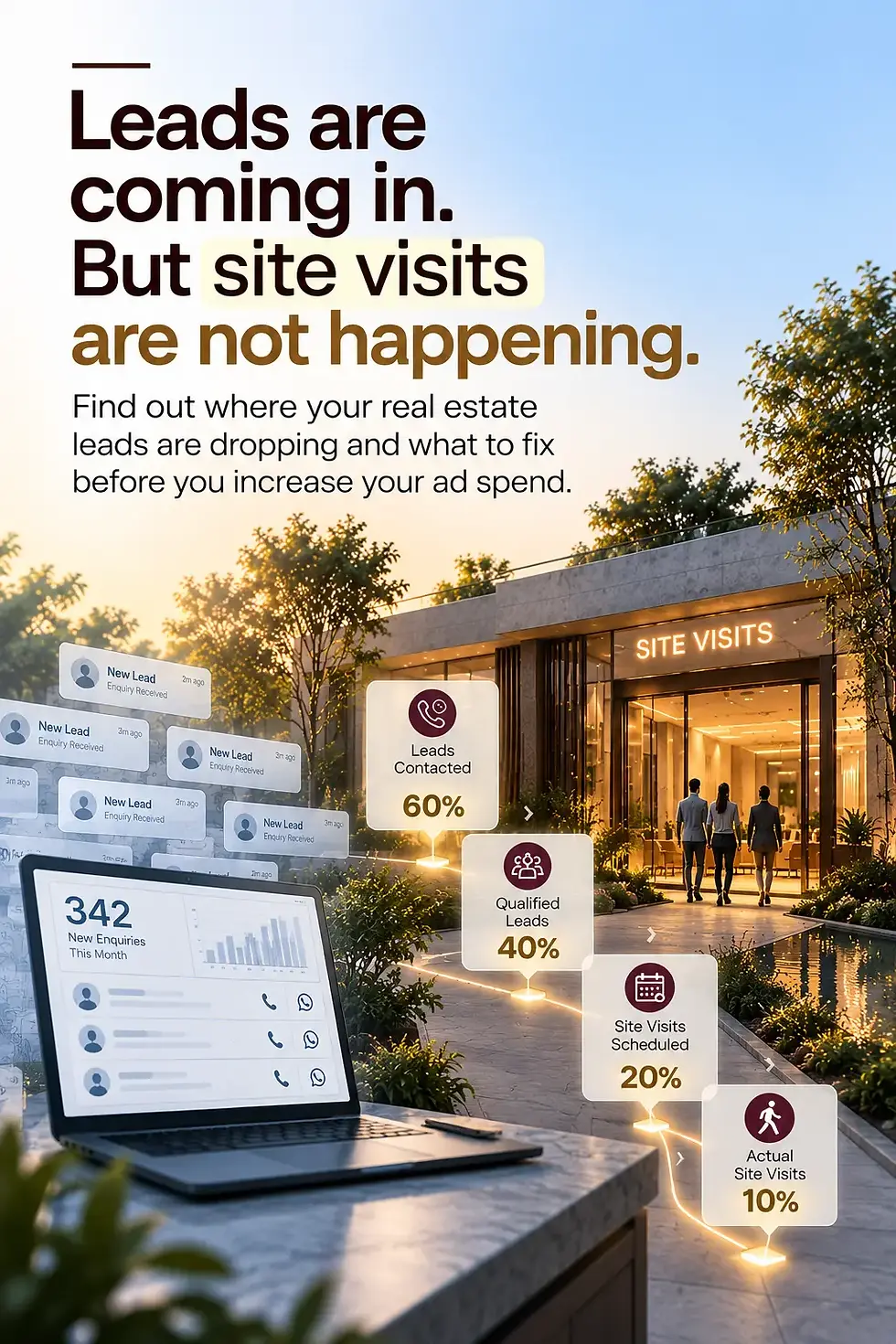
The real estate sales funnel runs from impression to enquiry, first contact, qualification, site visit, revisit, negotiation, booking, and CRM. Developers should measure conversion at every stage, find where the largest share of buyers is lost, and calculate cost per stage. Fix the leakiest stage before increasing the media budget.
What the real estate sales funnel actually is
Most developers carry a simple picture in their heads: advertise, collect leads, sell. The funnel looks like a short pipe with marketing at one end and bookings at the other.
In practice, the journey from a stranger seeing your project to a buyer signing a booking form has about ten distinct stages, run by different people, with different failure points. Marketing owns the first two or three. Presales owns the next few. Sales owns the site visit and negotiation. Finance, legal, and CRM own the last. A weak link at any stage caps everything after it.
That is why two projects with the same media spend can post very different booking numbers. The difference is rarely the advertising. It sits in the stages after the lead arrives.
This guide walks through every stage of the funnel, shows how to measure it, and gives the formulas to find where a project is losing buyers. If your project is not selling and you are not sure why, start with why a real estate project is not selling, then come back here for the measurement side.
The complete funnel at a glance
Think of the funnel as the commercial journey from the buyer's side:
Impression → Enquiry → First contact → Lead connected → Qualified prospect → Site visit scheduled → Site visit completed → Revisit → Negotiation → Booking → CRM and post booking
Behind this sits the work the developer does before a single advertisement runs: understanding the market, shaping the product, setting the price and building the developer's reputation. Those decisions determine how well every stage below performs. A funnel cannot convert a product that the micro market does not want at the price asked.
The table below summarises each stage, who owns it, and what usually goes wrong.
Stage | Who owns it | What it measures | Common failure |
Impression and click | Marketing | Reach and interest | Wrong audience, vague message |
Enquiry | Marketing | Intent to know more | Low trust, poor landing page |
First contact | Presales | Speed of response | Slow or missed calls |
Lead connected | Presales | Reachability | Wrong calling windows, fake numbers |
Qualified prospect | Presales | Fit with the project | Loose or no qualification |
Visit scheduled | Presales | Commitment to a date | Vague appointments |
Visit completed | Presales and sales | Show up | No confirmation routine |
Revisit | Sales | Serious interest | Weak site experience, poor follow up |
Negotiation | Sales | Price and terms discussion | Unclear pricing, no authority to close |
Booking | Sales and finance | Commitment | Objections left unresolved |
CRM and post booking | Sales and CRM | Documentation and referrals | Poor handover, no tracking |
Stage by stage: what happens and where buyers are lost
1. Impression and click
The funnel begins with a buyer seeing your project on a portal, in a social feed, a search result, on a hoarding, or through a channel partner. The measure here is reach and interest: impressions, clicks, and click through rate.
These are activity metrics. They tell you the campaign is running, not that it is working. A project can post strong impressions and clicks while attracting the wrong people, such as renters, investors who want a different product, or buyers who cannot afford the ticket. The audience definition matters more than the volume.
2. Enquiry
An inquiry happens when a buyer leaves a phone number, fills a form, or sends a message. This is the point at which most marketing reports declare a lead.
Buyers are lost: a landing page that does not answer the obvious questions of price range, location, and possession; a form that asks for too much; or an ad promise that the project cannot keep. If the enquiry stage is weak, the cost per lead rises. If the promise is wrong, the leak shows up later, when buyers feel they were misled.
3. First contact and 4. Lead connected
Speed and reachability decide this stage. How quickly does presales call after the enquiry, and how many leads are actually reached?
Buyers often enquire with several developers on the same day. A prompt, sensible first call counts for a great deal. Check the gap between enquiry time and first call, by hour of day and day of week. Check how many attempts are made before a lead is marked unreachable. Track the connect rate by source, because some sources deliver numbers that never answer.
5. Qualified prospect
Qualification separates genuine prospects from enquiries. A first call should establish purpose (self use or investment), budget range, timeline, current location and who else is involved in the decision.
Loose qualification fills the site visit calendar with people who will never buy and exhausts the sales team. Over strict qualification screens out buyers who simply do not share details on a first call. The right standard depends on the product, which is one reason published benchmarks are risky.
6. Site visit scheduled and 7. Site visit completed
A scheduled visit is a promise. A completed visit is a fact. The gap between them is a funnel stage of its own and tells you about appointment setting, confirmation, and trust.
A specific slot, a named person who will receive the buyer, and a reminder the day before all raise the show rate. A weak online presence or no reviews lowers it, because the buyer hesitates to give up a weekend for an unknown developer.
8. Revisit
For most residential purchases in Bengaluru, a single visit rarely leads to a booking. The buyer returns with a spouse, parents, or a friend, or visits a competing project and comes back to compare. A revisit is one of the strongest signs of serious interest, and many projects do not track it at all.
If completed visits are healthy but revisits are low, the visit itself is probably not persuasive. Check the model apartment or sample experience, the quality of the sales presentation, how the buyer was treate,d and what follow up happened in the days after.
9. Negotiation
Negotiation covers price, payment plan, unit choice, and terms. Buyers who reach this stage have already decided the project is a candidate. What decides the outcome is clarity on price, the sales team's authority to offer defined terms, and honest handling of objections.
Common failures: price communicated vaguely until the last moment, a sales team that cannot offer anything without long approvals, and discounts handed out without a rule, which teaches buyers to wait. Pricing integrity matters here, because buyers who book at full price talk to those who negotiate.
10. Booking
A booking is the point at which marketing and sales finally earn revenue. Closure depends on objection handling, urgency that is real and (not manufactured), and a smooth path througthe h the token amount, documentation, and payment.
Where buyers are lost: complexity in paperwork, unclear payment schedules, doubts about the developer's delivery, and competing offers from other projects. Track how many negotiations convert and why the rest do not. Lost reasons for lost deals recorded in the CRM are some of the most valuable data a developer holds.
11. CRM and post booking
The funnel does not end at the booking form. A buyer who is looked after after booking becomes a source of referrals, positive reviews, and smooth collections. A buyer who is ignored becomes a complaint.
CRM is also the record that makes everything above measurable. If the CRM does not capture source, stage, timestamps and lost reasons, no one can say where the funnel leaks. Many developers have a CRM but use it as a contact list.
How to calculate conversion at every stage
Stage conversion is the share of people who move from one stage to the next.
Stage conversion rate = Number reaching the next stage ÷ Number at the current stage
Overall conversion = Bookings ÷ Total enquiries
Common stage measures:
Measure | Formula |
Click through rate | Clicks ÷ Impressions |
Enquiry rate | Enquiries ÷ Clicks |
Contact rate | Leads contacted ÷ Enquiries |
Connect rate | Leads connected ÷ Leads contacted |
Qualification rate | Qualified leads ÷ Leads connected |
Scheduling rate | Visits scheduled ÷ Qualified leads |
Show rate | Visits completed ÷ Visits scheduled |
Revisit rate | Revisits ÷ Visits completed |
Negotiation rate | Negotiations ÷ Revisits |
Closure rate | Bookings ÷ Negotiations |
Two cautions apply. First, define each stage in writing before measuring it. What counts as "connected" or "qualified" must be the same for every caller and every month. Second, follow cohorts where possible. Buyers who enquire in October may book in January, so compare October's leads with their eventual outcome rather than October's leads with October's bookings.
A worked example with hypothetical numbers
The figures below are made up to show the method. They are not benchmarks and should not be compared with any real project.
Assume a campaign spend of Rs 6,00,000 and an average booking value of Rs 1.2 crore.
Stage | Count | Conversion from previous stage |
Impressions | 2,000,000 | n/a |
Clicks | 20,000 | 1.0% |
Enquiries | 1,000 | 5.0% |
Contacted | 900 | 90.0% |
Connected | 640 | 71.1% |
Qualified | 280 | 43.8% |
Visits scheduled | 120 | 42.9% |
Visits completed | 70 | 58.3% |
Revisits | 30 | 42.9% |
Negotiations | 18 | 60.0% |
Bookings | 8 | 44.4% |
Overall, 8 bookings came from 1,000 enquiries, a conversion of 0.8% conversion rate.
Funnel leakage analysis
Leakage means the buyers lost at each stage. Looking at where the largest numbers disappear shows where to work first.
Stage transition | Lost | Share of all enquiries lost here |
Enquiry to contacted | 100 | 10.1% |
Contacted to connected | 260 | 26.2% |
Connected to qualified | 360 | 36.3% |
Qualified to scheduled | 160 | 16.1% |
Scheduled to completed | 50 | 5.0% |
Completed to revisit | 40 | 4.0% |
Revisit to negotiation | 12 | 1.2% |
Negotiation to booking | 10 | 1.0% |
Of the 992 enquiries that did not become bookings, the largest share (about 36%) dropped out between connection and qualification. The next largest was between contact and connection (about 26%).
A careful reader should resist the obvious conclusion. Losing a lot of people early is normal, because many enquiries are casual. A better question is which stage can be improved cheaply and which improvement is worth the most. The 50 buyers lost between scheduled and completed visits are fewer than the 360 lost at qualification, but they are cheaper to recover, since they have already agreed to come. Read leakage together with cost and effort.
Also note the late stages. Only 18 of 280 qualified buyers reached negotiation, and 8 of those booked. Each booking at the end of the funnel is expensive to replace, so an improvement in closure rate from 44% to 55% would add 2 bookings without a single extra lead.
Cost per stage
Cost per stage divides spend by the count at each stage. For the example above:
Stage | Formula | Cost |
Cost per thousand impressions | Spend ÷ (Impressions ÷ 1,000) | Rs 300 |
Cost per click | Spend ÷ Clicks | Rs 30 |
Cost per lead | Spend ÷ Enquiries | Rs 600 |
Cost per connected lead | Spend ÷ Connected | about Rs 938 |
Cost per qualified lead | Spend ÷ Qualified | about Rs 2,143 |
Cost per scheduled visit | Spend ÷ Scheduled | Rs 5,000 |
Cost per completed visit | Spend ÷ Completed | about Rs 8,571 |
Cost per negotiation | Spend ÷ Negotiations | about Rs 33,333 |
Cost per booking | Spend ÷ Bookings | Rs 75,000 |
Booked revenue in this example, booked revenue is 8 bookings at Rs 1.2 crore, or Rs 9.6 crore. Marketing cost as a share of booked revenue is about 0.6%.
The cost rises sharply as you move down the funnel because fewer buyers remain. That is how the funnel works. What matters is whether the final figure is acceptable for the product and whether it is improving. A lower cost per lead is not a goal in itself. If it comes at the cost of lead quality, cost per booking will rise.
Remember that media spend is only part of the cost of a sale. Presales salaries, channel partner brokerage, creative, events, and fees all add to it.
Why your funnel will not look like anyone else's
Developers often ask for benchmark conversion rates for each stage. We do not offer them, because any single table would mislead.
Our view, shaped by Kauser Ahmedd's roughly 23 years in Bangalore real estate, is that sales funnels are not standardised. Each has its own mix of product, price, and market. A villa project in one part of Bengaluru can convert well while the same product elsewhere struggles. Farmland converts at a low rate and site visits take longer to arrange. Ticket size changes how many visits a buyer makes before deciding. Apartments, villas, plots,, and farmland each behave differently, and so do the launch phase and sustenance phase.
The most useful comparison is your own project against its earlier months, and one source against another within the same project. If connect rate drops, a campaign is attracting different people. If show rate falls, appointment setting has weakened. If revisits are low, the site experience needs work. The funnel is a diagnostic tool, not a scoreboard to copy from someone else.
Fixing the funnel in the right order
Work from the stage that gives the biggest gain for the least cost, and remember that earlier stages feed later ones.
Make the stages measurable. Define each stage, set up the CRM fields, and record lost reasons. Without this, everything else is opinion.
Fix first contact and qualification. Response speed, calling windows, and a consistent qualification standard cost little and affect every stage after.
Tighten appointment setting. Specific slots, named hosts,s and reminders raise the show rate with no extra media spend.
Improve the site experience. Revisit rate is a clear signal of how persuasive the visit was.
Clarify pricing and negotiation rules. Buyers should hear the price early, and the sales team should know what they can offer.
Work on closure and objection handling. Study the lost reasons and train on the ones that repeat.
Only then revisit the media budget. Increase spend once the funnel can convert what it receives.
Throughout, the aim is sales velocity and absorption, not a prettier dashboard. Kanopy builds a developer's reputation first, through the business profile, reviews, content, and visibility, so that performance marketing then works on a funnel that buyers trust. The detail of how we do that stays inside our engagements, but the principle holds for any project: the funnel only performs only as well as the trust and clarity at its top.
Frequently asked questions
What are the stages of the real estate sales funnel?
Impression, enquiry, first contact, lead connected, qualified prospect, site visit scheduled, site visit completed, revisit, negotiation, booking, and CRM with post booking follow up. Each stage has its own owner and its own measure of success.
How do you calculate conversion at each stage of a real estate funnel?
Divide the number who reach the next stage by the number at the current stage. For example, show rate is visits completed divided by visits scheduled. Overall conversion is bookings divided by total enquiries.
What is funnel leakage in real estate?
Funnel leakage is the loss of buyers between stages. Analysing it means counting how many are lost at each transition and judging which stage can be improved at the lowest cost for the largest gain.
What is a good conversion rate for a real estate sales funnel?
There is no universal figure. It depends on product type, ticket size, location, launch stage, and lead source. Compare a project against its own earlier performance and between its own sources.
How do you calculate cost per stage in a real estate funnel?
Divide total spend by the number reached at each stage. Cost per lead, cost per qualified lead, cost per completed visit, and cost per booking are the usual measures, and cost rises as the funnel narrows.
Where do most real estate leads drop out of the funnel?
It varies by project. Common drop-off points are between enquiry and connection, and between connection and qualification, but each project should find its own largest leak by measuring each stage.
Should a developer increase marketing spend if bookings are low?
Not before checking the funnel. If a large share of buyers is lost after the enquiry, more leads mostly add to the leak. Fix the leakiest stage first and then review the budget.
What is the difference between a lead and a booking in real estate?
A lead is an enquiry from someone who showed interest. A booking is a committed purchase. A lead is not the outcome of marketing. A booking is.
Your Project Is Generating Leads. But Is It Generating Enough Bookings?
For a real estate developer, success is not measured by the number of enquiries received. It is measured by sales velocity, inventory absorption, revenue realisation and predictable cash flow.
At Kanopy Ventures, we work with developers in Bangalore to identify what is slowing down project sales and implement strategies that improve conversions.
From market-aligned pricing and project positioning to channel partner activation, presales management, site visit conversions, and closures, we take responsibility for the sales process, not just lead generation.
Every unsold unit represents capital waiting to be realised.
Whether you are preparing for a new launch, struggling with slow moving inventory, or looking for a dedicated sales mandate partner, let's discuss how Kanopy Ventures can improve your project's sales performance.
CTA: Let's Discuss Your Project's Sales Potential
Call or WhatsApp: +91 91208 25825
Website: www.kanopyventures.com