
What Is a Plotted Development? A Practical Guide for Bengaluru Buyers

Written by Kauser Ahmedd, Founder and Managing Partner, Kanopy Ventures. Published by Kanopy Ventures. Published: 8 October 2026
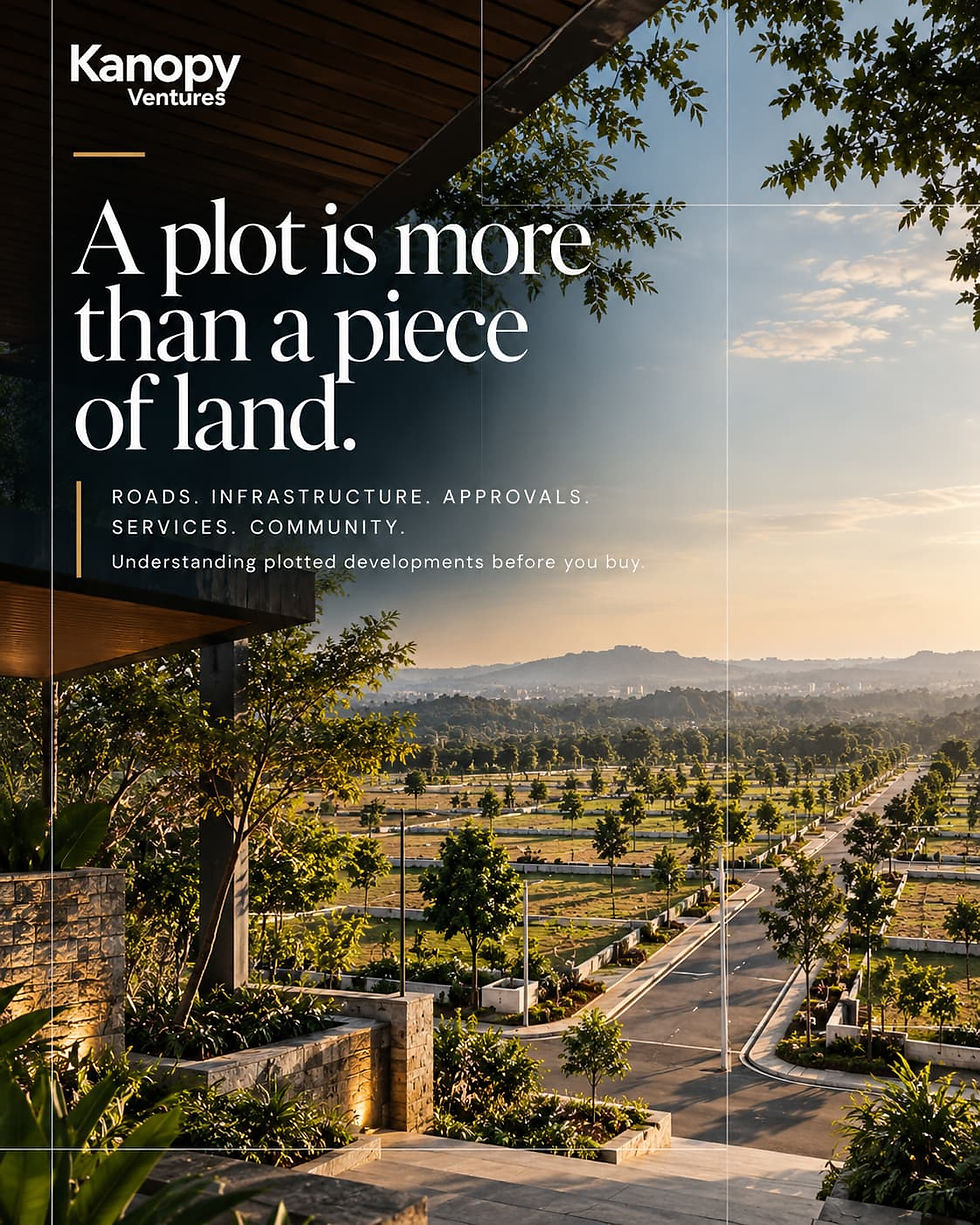
A plotted development is a planned layout in which a larger parcel of land is divided into individual residential plots, with dedicated internal roads, drainage, water and power infrastructure, and sold to separate buyers. In most cases you buy the demarcated plot, not a built house, and you arrange construction yourself within the layout's approved rules, unless the offer clearly says otherwise.
This guide is for buyers in Bengaluru who are comparing land, plots, layouts, and villas for the first time. It explains the terms, what to establish before you compare projects, why not every plot in an approved layout is available to buy on day one, and which questions to ask at the first enquiry. It does not recommend any plot, project or location as an investment.
Land, plot, plotted layout and villa: how the terms differ
Advertisements often used loosely in advertisements. The table shows how they are commonly understood. Inclusions vary by project, so the sale agreement and the written offer decide what you actually get.
Term | What it usually means | What you typically buy | The first question to ask |
Land | A parcel of ground, which may or may not be approved for residential use | A piece of land, with its permitted use depending on the records | What is the permitted use of this land today? |
Individual residential plot | A single site meant for building a home | The plot, with construction left to you | Is this plot part of an approved layout, and how is its boundary marked? |
Plotted layout (plotted development) | A parcel divided into many plots with internal roads and common areas | A plot, plus a share in how the layout's common facilities are managed | What infrastructure and amenities are promised, and who maintains them? |
Villa plot | A plot marketed for a villa. The term is not standardised, so check what it means in each project | Usually a plot, sometimes a plot with a construction package | Is construction included, and where is that written down? |
Built villa | A completed independent house, often on a small plot within a community | A house together with its plot share, as defined in the agreement | What exactly is sold: the house, the land, or both, and on what terms? |
Two points are worth holding on to. A plotted layout is a way of organising and selling land, not a guarantee of quality. And "villa plot" can mean different things in different advertisements, so ask for the definition in writing.
What to establish before you compare projects
Comparing prices before you have established the basics tends to mislead. Start with these five areas.
Location
Look at the actual site, not just the locality name. Check how you would reach it, how far the nearest daily needs are, and what the surroundings are like at different times of day. Visit more than once if you can.
Permitted use
Confirm that the land is approved for residential use and that the layout carries the approvals it should. The relevant authority depends on the location, so ask the seller which authority approved the layout and verify that with the authority or your lawyer. Do not rely on a brochure.
Services
Ask what is in place today and what is promised for later: internal roads, drainage, water supply, power connection, and street lighting. Note the difference between what is built, what is under constructio,n and what is only planned.
Status
Ask whether the project is complete, under development, or at prelaunch, and what documents support that. A launch event or an advertisement is not proof of status. Where registration or approval applies, ask for the registration or approval details and check them on the official record.
Future construction
Ask what you may build on the plot: the height, the setbacks, and any design rules in the layout. Ask when you can start building and whether any construction permission is needed from the authority or the layout's association. Check these before you pay, not after.
Approved does not mean every plot is available: phased release
This is the point many first time buyers miss. When a plotted development is approved, it is not always the case that every plot in the layout can be sold straight away. In many projects the plots are released for sale in phases, tied to how far the development work has progressed.
Here is an illustration of how a phased release can work. The percentages and steps are an example from Kanopy Ventures' understanding, not a fixed rule, and they differ by project and approving authority.
Phase | What may happen | Share of plots available |
First release | After approval, a first portion of the plots is released for sale | Around 40% in this example |
Second release | The developer carries out part of the development, shows the progress to the authority, and a further portion is released | Around another 40% in this example |
Final release | The developer completes the developmen,t and the remaining plots are released | The remaining 20% or so in this example |
What this means for you:
Buy only from the released portion. Make sure the plot you are buying sits in a phase that has actually been released for sale. A plot in a later phase may not be available to sell or register yet.
Ask for the evidence. Ask the seller which phase your plot belongs to and for the documents that show its release. Have your property lawyer confirm this against the approving authority's records.
Ask what happens to later phases. If your plot is in a later phase, ask when it is expected to be released, what has to happen first, and what the agreement says if the timeline slips.
Do not rely on a plot number alone. A plot number on a brochure or a price list does not tell you whether that plot has been released.
Why your purpose changes what matters
Your reason for buying shapes which checks matter most. This is a way to organise your thinking, not a recommendation to buy.
Purpose | What to look at more closely |
Building soon | Plot shape and size for your design, services already in place, construction rules, the time and cost of getting permissions, and access for building material |
Building later | The rules on timelines or conditions for construction, how the layout will be maintained in the meantime, and whether the services promised will be ready by the time you build |
Holding the land | Carrying costs, who maintains the boundary and the plot, how you would verify its condition from a distanc,e and what your options are if circumstances change |
Holding land has costs and risks as well as possible gains, and outcomes are not guaranteed. Decide your purpose first, then test each project against it.
Kanopy Ventures' point of view: know your exit before you buy
The following is Kanopy Ventures' opinion based on its experience in real estate sales and marketing advisory. It is not a market forecast, not a price benchma,rk and not a recommendation to buy any plot.
A plotted development can be a good purchase. Whether it is a good purchase for you depends on the price you pay, the buyer you can expect to sell to later, and the price that buyer is likely to accept. In Kanopy Ventures' experience, most plot buyers in this segment buy with eventual resale in mind. If that is you, be clear on three things before you commit:
Entry price: what you are paying per sq ft, and how that compares with similar plots nearby that are actually on offer.
Exit buyer and exit price: who would realistically buy your plot from you, and at what price.
Exit timeline: how long it could take to find that buyer, and what you would do if it takes longer.
If you cannot answer these, Kanopy Ventures' view is simple: do not buy yet.
Two cautions follow from this view:
Resale takes time. Buyers of resale plots are often slow to pay a higher price, and a plot you want to sell competes with other options the buyer has. Plan for a longer wait than you would like.
Be careful in low rate micro markets. Kanopy Ventures advises caution about buying in areas where plots currently sell at around ₹3,000 to ₹5,000 per sq ft purely because a large developer, often called a Category A developer, has launched or announced a project nearby project. In our view, a well known name arriving does not, by itself, mean that the next buyer will pay more when you want to sell. Treat that as an opinion to test, not a rule.
More broadly, Kanopy Ventures currently regards price growth that depends on large developer launches as an unsustainable basis for an exit plan. If your plan to sell rests only on that, treat it as a weakness.
Exit strategy questions to answer before buying
Who is the likely next buyer for this plot: a self builder, an investor, or a developer?
What are comparable plots in this micro market actually offered at today, and is that an advertised rate or a rate at which sales have closed?
How many comparable plots are for sale at the same time, and how long have they been listed?
What costs will I face when I sell, such as charges, taxes, and brokerage?
If I need to sell sooner than planned, what would that cost me?
First enquiry checklist for plot buyers
Take this list to your first call or site visit. Ask for answers in writing where you can.
About the project
Is this an approved layout? Which authority approved it, and what is the approval reference?
Is the project registered where registration applies? What is the registration number?
Who is the developer, and who owns the land? Are they the same?
What is the current status: complete, under development, or prelaunch?
Is my plot in a phase that has been released for sale? What documents show this?
If my plot is in a later phase, when is it expected to be released, and what is the position until then?
About the plot
Is the plot demarcated on site, and can I see the boundary marks?
What is the plot size, and how is it measured?
What is the exact plot number, and which direction does it face?
Is the plot free of disputes, and what documents show this?
About services and amenities
Which services are in place today, and which are promised for later?
If amenities are promised, when are they due and who maintains them afterwards?
Is there a maintenance charge, and how is it set?
About construction and use
What can I build, and are there design or height rules in the layout?
Does the price include any construction package or villa offering? If so, where is it described in the agreement?
When am I allowed to start building?
About price and payment
What exactly does the quoted price include?
What other costs apply, such as registration charges, maintenance deposits, or fees for connections?
What is the payment schedule, and what happens if the schedule changes?
About resale
Who is the likely buyer if I want to sell later, and at what price?
How long might a resale take in this area?
About the paperwork
Can I see the draft sale agreement before I commit any money?
Which documents will my lawyer need to see, and when will they be provided?
Who checks what
You do not have to judge legal and technical matters on your own, and you should not rely on the seller to do it for you. A sensible split looks like this:
Matter | Who is best placed to assess it |
Title, ownership history, agreements and legal documents | A property lawyer you appoint |
Whether your plot is in a released phase | The approving authority's records, confirmed by your property lawyer |
Boundaries, plot area and measurements | A licensed surveyor |
Soil, building feasibility, setbacks and design | A civil engineer or architect |
Loan eligibility and terms | The lender, from its own product documents |
Approval status and records | The relevant official authority, through its records |
The seller can explain the project, but title and compliance checks are best done by people who work for you.
Frequently asked questions
What does plotted development mean?
A plotted development is a project in which a parcel of land is divided into individual residential plots, usually with internal roads and some common infrastructure, and sold to buyers who build their own homes. What is included differs from project to project. Some offer only the plot and basic services, others add amenities, and some add construction. Ask for the inclusions in writing.
Does buying a plot include construction of a house?
Not usually. In most plotted developments, you buy the land and arrange the construction yourself. Some projects, often marketed as villa plots or villa communities, offer a house on the plot, either as part of the sale or as a separate package. The agreement and the written offer decide what is included, not the brochure or a verbal promise.
Are all the plots in an approved plotted development available for sale?
Not necessarily. In many project,s the plots are released in phases as development progresses. For example, a first portion may be released after approval, a further portion after part of the development is completed and shown to the authority, and the remainder after the development is finished. The exact shares and steps vary by project and authority. Before you buy, confirm that your plot is in a phase that has been released, and have your lawyer check this against official records.
Is a plotted development a good investment?
It can be, but it depends on the price you pay, who you can sell to later, and the price they will accept. Kanopy Ventures' view is that you should be clear on your entry price, your likely exit buyer, and your exit timeline before you buy. Resale can take time, and a well known developer launching nearby does not guarantee that a later buyer will pay more. This is an opinion, not a forecast or advice for your situation, and outcomes are not guaranteed.
What should a first time plot buyer check first?
Start with your purpose: whether you plan to build soon, build later, or hold the land, and if you may sell later, what your exit plan is. Then set a total budget that includes more than the plot price, and shortlist locations that suit your daily routine. Confirm that the plot you want is in a released phase. Before you commit, have a property lawyer review the documents and a qualified professional assess the plot and the site. Those checks protect you more than any comparison of advertised rates.
Use the checklist before you
compare projects
Take the first enquiry checklist above to every site visit and ask each developer the same questions, in the same order. Written answers make projects easier to compare fairly.
Developer or landowner planning a plotted project? See how Kanopy Ventures helps developers position a plotted project.
Kanopy Ventures.
Consult. Curate. Liquidate.
📩 hello@kanopyventures.com | 📞 9120825825 | 🌐 kanopyventures.com


